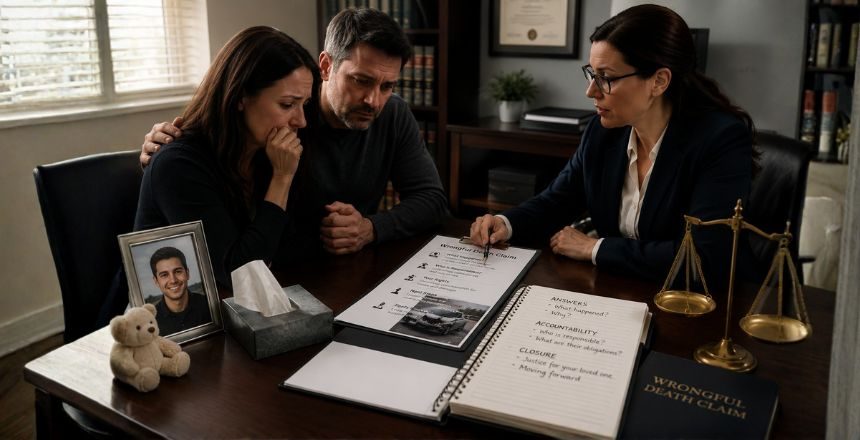
Nobody sits down and plans for this. A family in Kent gets a call they weren’t expecting. A father in Auburn doesn’t come home from a job site. A mother in Renton goes in for a routine procedure, and the outcome is unthinkable. And suddenly, a family that was going about its normal life is left trying to figure out funeral arrangements, hospital bills, and what on earth they’re supposed to do next.
If the death happened because someone was careless or negligent, a wrongful death claim may be one of the most important legal tools available to your family. It won’t bring anyone back. But it can help hold the right people accountable, provide financial support when it matters most, and give families the answers they truly deserve.
The CDC consistently lists unintentional injuries among the leading causes of death in the United States. A significant portion of those deaths involve negligence causing death, and many families don’t realize they have legal options until months later, sometimes too late.
What Is a Wrongful Death Claim and Why Does It Matter
Here’s the simplest way to understand it: a wrongful death claim is a civil lawsuit filed when someone dies because of another person’s or organization’s negligence. It is separate from a criminal case, which means no one goes to prison because of the claim itself. But the family receives compensation, and the responsible party faces real, tangible consequences.
In Washington State, these claims are filed through civil court and cover situations that many people wouldn’t immediately associate with a lawsuit.
What Families Are Dealing With | How the Claim Can Help |
| Unexpected medical bills | Recoverable as economic damages |
Funeral and burial costs | Included in the financial claim |
| Loss of the deceased’s income | Calculated based on future earning potential |
Emotional toll and grief | Addressed through non-economic damages |
A civil lawsuit for death is, at its core, about making sure the burden of a preventable loss doesn’t fall entirely on the people who had nothing to do with causing it.
Common Causes of Wrongful Death Cases You Should Know
The types of incidents that lead to wrongful death cases are more varied than people expect. In communities like Auburn, Renton, and Kent, where roads are busy, construction is constant, and medical facilities serve large populations, the circumstances that give rise to these cases are, unfortunately, not rare.
Some of the most frequent causes include:
- Serious car and truck accidents where another driver was clearly at fault
- Medical errors range from misdiagnosis to surgical mistakes and medication failures
- Fatal workplace accidents, particularly in construction and industrial settings
- Hazardous property conditions that a landlord or business neglected to address
- Defective products or vehicle components that failed without any warning
The National Highway Traffic Safety Administration tracks fatal crash data nationally, and the findings are remarkably consistent year over year: most of these deaths involve preventable behavior. That is the legal foundation of a fatal accident claim. Someone made a choice a reasonable person wouldn’t have made, and someone else paid for it with their life.
Worth knowing: If you’re unsure whether your situation qualifies, speak with a wrongful death attorney before drawing your own conclusions. What seems like a gray area often isn’t once an attorney reviews the full picture.
Who Can File a Claim and What Are Their Rights?
Washington law is clear on who has the right to bring a wrongful death lawsuit forward. Generally speaking, that includes:
- Spouses and registered domestic partners
- Children of the deceased
- Parents, under specific qualifying circumstances
If your family situation is complicated, or if estate and probate matters are already in motion, your legal rights after a fatal accident may be affected by factors you haven’t considered yet. That’s not meant to discourage you; it’s a reason to get a proper legal assessment rather than guessing on your own.
One thing worth mentioning for families in Maple Valley and Renton: wrongful death claims and probate proceedings frequently overlap. Handling both through a single legal team that understands both areas of law saves significant time and stress during an already difficult period.
The Role of Evidence in Proving Accountability
Proving liability in death cases comes down to documentation, and time genuinely is not on your side. Surveillance footage is deleted on a routine schedule. Witnesses become harder to track down. Physical evidence at accident scenes disappears within days of the incident.
Here’s what typically forms the backbone of a strong case:
Evidence Type | Why It Matters |
| Police and incident reports | Captures what was officially recorded right away |
Medical records | Connects the cause of death to the negligent act |
| Witness statements | Corroborate the timeline and sequence of events |
Surveillance footage | Objective visual documentation that is hard to dispute |
| Expert testimony | Explains to a judge or jury how negligence occurred |
Financial and employment records | Quantify the full economic loss to the surviving family |
The Bureau of Labor Statistics documents thousands of fatal workplace injuries across the U.S. each year, and in many of those cases, the safety violations were already on record somewhere before the death occurred. When that kind of documentation exists, it becomes central to any accident-related death compensation claim. The takeaway: preserve everything early, because what you document now determines what you can prove later.
Types of Compensation Families May Be Entitled To
Wrongful death compensation falls into two categories, and both matter more than most families initially realize.
Economic damages are the losses you can actually attach a dollar amount to:
- Medical bills from the final days or weeks of the deceased’s life
- Funeral and burial costs, which add up faster than most families expect
- Lost income and the future earnings the deceased would have gone on to provide
- Lost benefits, pension contributions, and other financial support the family depended on
Non-economic damages cover what no invoice ever could:
- The loss of companionship and the everyday presence of someone you loved
- Grief, emotional suffering, and the psychological toll that lingers long after the loss
- For children who lose a parent, the absence of guidance and care through every stage of growing up
Compensation in wrongful death cases looks different for every family. It depends on the age and income of the person who died, how many people relied on them financially, and how strong the evidence turns out to be. There is no honest way to put a number on it before someone has reviewed the full picture. Anyone who does is guessing.
Finding Closure Through Legal Action: What to Expect Next
Knowing how a wrongful death case timeline typically unfolds gives families a clearer sense of what they are actually signing up for when they choose to move forward. In Washington, the process generally follows these stages:
- A legal representative is formally appointed to act on behalf of the estate
- The investigation begins: evidence is gathered, liability is analyzed, and expert opinions are secured
- Negotiations take place between the legal teams and any insurance carriers involved
- If a fair resolution is reached, the case settles; if not, it moves into litigation
Washington State’s statute of limitations gives families roughly three years to file a wrongful death lawsuit, but that window closes faster than people expect, especially when grief is consuming so much energy. If you’re weighing your loss of a loved one’s legal options, starting the conversation sooner rather than later keeps all of those options open.
Grief Deserves More Than Silence. Here Is How to Take the Next Step.
Families in Kent, Maple Valley, Auburn, and Renton who are facing the aftermath of a fatal accident don’t have to navigate it alone. Iddins Law Group supports families through wrongful death and personal injury matters, and also handles probate and estate-related proceedings, so you’re not juggling multiple firms while managing your grief. If financial recovery after wrongful death is something your family needs to understand, the right first step is one straightforward conversation.
Call Iddins Law Group at (253) 854-1244 to schedule your consultation with our team today.
FAQs
1. What legally qualifies as a wrongful death claim?
A wrongful death claim arises when someone dies as a direct result of another party’s negligence or misconduct. Car accidents, medical errors, workplace incidents, and dangerous property conditions are all common examples.
2. Who is eligible to file a wrongful death lawsuit?
In Washington, spouses, domestic partners, children, and, in some cases, parents may have the right to file. Eligibility depends on family structure and applicable state law.
3. How is a wrongful death case different from a personal injury claim?
A personal injury claim is filed by the injured person. A wrongful death case is brought by surviving family members after that person has died.
4. What types of compensation can families recover in a wrongful death case?
Families may recover medical costs, funeral expenses, lost income, and non-economic losses. What a surviving family actually walks away with depends entirely on the facts of their situation, because no two wrongful death cases are identical.
5. How long do I have to file a wrongful death claim?
Washington State generally gives families three years to file, though certain circumstances can affect that window. Reaching out to a wrongful death attorney sooner rather than later is the best way to make sure nothing gets missed before deadlines become a problem.
6. What evidence is needed to prove wrongful death?
Proving wrongful death requires more than a single document or a witness statement. Attorneys typically piece together police reports, medical records, surveillance footage, expert analysis, and financial records that support the full scope of proving liability in death cases.